Many people think investing is for those with thousands of dollars to spare. That belief keeps beginners on the sidelines for years, and waiting is usually the most expensive choice. In reality, $100 is enough to open an account, buy your first investment, and build the habit that matters far more than the starting amount.
This guide walks you through the process in plain language, from getting ready to making your first purchase.
Step 1: Make Sure You’re Ready to Invest
Check three things before any money goes into the market.
Handle high-interest debt first. If a credit card charges 20% or more, paying it down is a guaranteed return no investment can reliably match.
Have a small safety cushion. If your car breaks down and you have no savings, you may be forced to sell investments at a bad moment. Keep an emergency fund in a regular savings account, ideally growing toward three to six months of expenses.
Only invest money you won’t need soon. Money needed within the next few years belongs in savings, not the stock market.
Step 2: Decide What You’re Investing For
“Make money” is not a goal. A useful goal has a purpose and a timeline, such as retirement decades away or a milestone in ten years.
Your timeline shapes everything. A goal 20 or 30 years away can tolerate market swings, since diversified portfolios have historically recovered from downturns given enough time. A goal two years away cannot. This guide assumes you’re thinking long term.
Step 3: Understand the Basics in Five Minutes
You don’t need a finance degree. You need to understand four terms.
- Stock: a small slice of ownership in a single company.
- Bond: a loan you make to a company or government that pays you interest.
- Fund: a basket that holds many investments at once, so you don’t have to pick them one by one.
- Index fund or ETF: a low-cost fund that simply tracks a broad market index, such as a large group of well-known companies. ETF stands for exchange-traded fund, and it trades like a stock.
The key idea is diversification: spreading your money across many investments so that one failure doesn’t sink you. With $100, the easiest way to diversify is through funds rather than individual stocks.
Step 4: Choose Where to Open Your Account
You’ll need an account with a brokerage. Many now offer no minimum deposit, no commission on stock and ETF trades, and fractional shares, which let you buy a piece of a share instead of the whole thing. That last feature is what makes $100 workable.
When comparing providers, look for:
- No account minimum or a very low one
- Fractional shares, so every dollar goes to work
- Low or zero fees on the funds you plan to buy
- Proper regulation in your country, so confirm the provider is licensed
Where available, tax-advantaged accounts for retirement or long-term investing can reduce your tax bill. Rules differ by country, so check what applies where you live.
Step 5: Pick Your First Investment
This is where beginners freeze, so here is the calmest answer available: for most people starting out, a low-cost, broadly diversified index fund or ETF is a sensible core holding. It gives you exposure to hundreds or thousands of companies in a single purchase, with minimal fees and no need to predict winners.
Pay attention to the expense ratio, which is the yearly fee the fund charges. Many broad index funds charge a fraction of one percent, and over decades that difference compounds in your favor.
Here is one example of how you might divide your first $100. It is an illustration, not personal advice, and you should adjust it to your own situation.
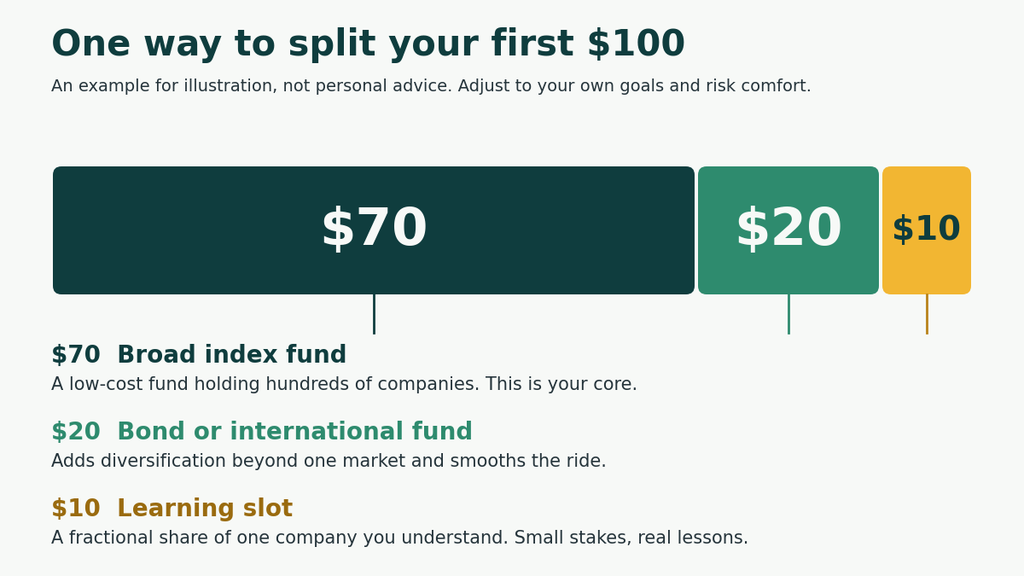
The logic is simple. Most of the money goes into a broad index fund as your core. A smaller portion goes into a bond or international fund for diversification. A small “learning slot” lets you buy a fractional share of a company you understand, which teaches you how ownership feels without risking much. If this feels like too many moving parts, putting the entire $100 into one broad index fund is perfectly reasonable.
Step 6: Make Your First Purchase
Once your account is funded, search for the fund by name or ticker symbol, enter a dollar amount rather than a share count, and choose a market order, which buys at the current price. Confirm, and you’re an investor.
Feeling a little nervous is normal. Remember that this is a $100 lesson with a small downside and a large educational upside.
Step 7: Automate and Add a Little Each Month
Here’s the part that matters most. Your first $100 won’t change your life. The habit of adding to it will.
Set up an automatic transfer, even if it’s only $10 or $25 a month. Automation removes the temptation to time the market, and it means you’re buying consistently whether prices are high or low. This approach is often called dollar-cost averaging.
To see why consistency matters, look at what happens in a hypothetical example: you start with $100 and add $25 every month for 20 years, assuming a 7% average annual return.
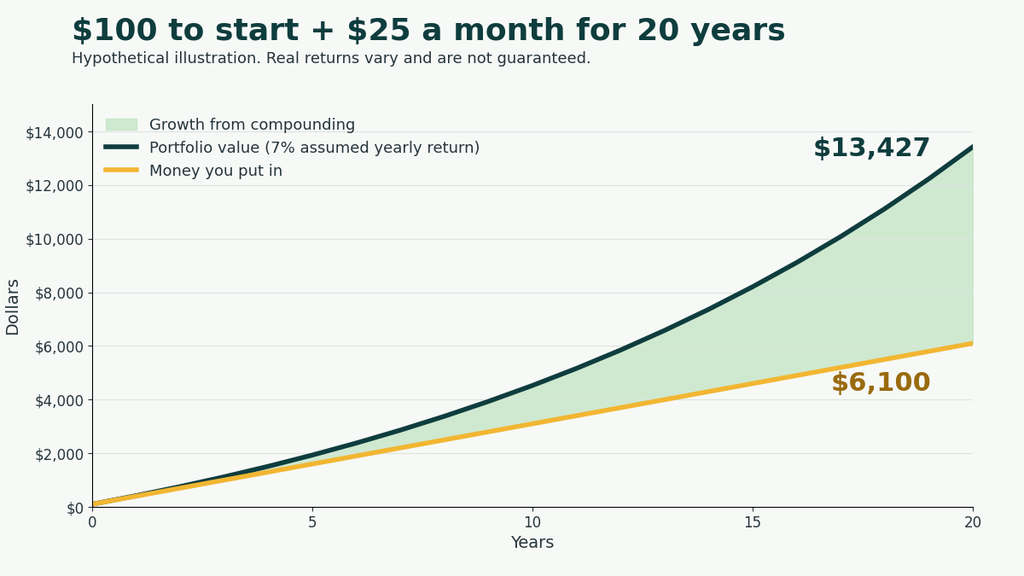
In this illustration, you contribute $6,100 of your own money, and the portfolio grows to roughly $13,400. More than half the final balance comes from growth rather than deposits. For comparison, the original $100 left alone for 20 years at the same assumed return would grow to only about $400, which shows that the monthly habit does most of the heavy lifting.
A caution is essential here: 7% is an assumption, not a promise. Real returns vary year to year, and some years will be negative. The chart simply shows the shape of compounding, not a forecast.
Step 8: Keep Costs Low and Stay Calm
Fees and behavior quietly decide how well beginners do.
Fees erode returns slowly but relentlessly. Stick to low-cost funds, avoid frequent trading, and be wary of high commissions or sales charges.
Behavior is harder. When markets drop, the urge to sell is powerful, and selling after a decline is how temporary losses become permanent. Decide ahead of time that you won’t check your balance daily or react to headlines.
Common Mistakes to Avoid
- Chasing hot tips. By the time a stock is all over social media, the easy gains have usually happened.
- Betting everything on one stock. A single company can fall dramatically.
- Trying to time the market. Even professionals struggle to do it consistently.
- Waiting for the perfect moment. There isn’t one.
Your Action Plan
Keep it simple. This week, you can:
- Pay down any high-interest debt and set aside a small emergency cushion.
- Write down one goal and its timeline.
- Open an account with a low-cost, regulated brokerage.
- Buy a broad index fund or ETF with your $100.
- Set up a small automatic monthly contribution.
- Leave it alone and let time work.
The Bottom Line
Investing with $100 isn’t about the amount. It’s about starting, learning with low stakes, and building a habit that grows alongside your income. Start small, stay consistent, keep costs low, and give it time.
Disclaimer: This article is for educational purposes only and is not financial, tax, or legal advice. All investments carry risk, including the possible loss of principal, and past performance does not guarantee future results. Consider speaking with a licensed financial professional about your own situation.
Please wait…
Your Code
This code is fixed and not randomly generated.