The best credit card isn’t the one with the biggest welcome bonus. It’s the one that matches how you actually spend and pay. A card that earns 2% back is wasted if you carry a balance at 25% interest, and a $95 travel card is a bad deal if you fly once a year.
This guide covers three jobs a card can do: earn cashback, fund travel, or help you pay down debt. Details reflect October 2026 and the US market, but issuers change terms often, so confirm everything on the issuer’s site before applying.
First, Pick the Job
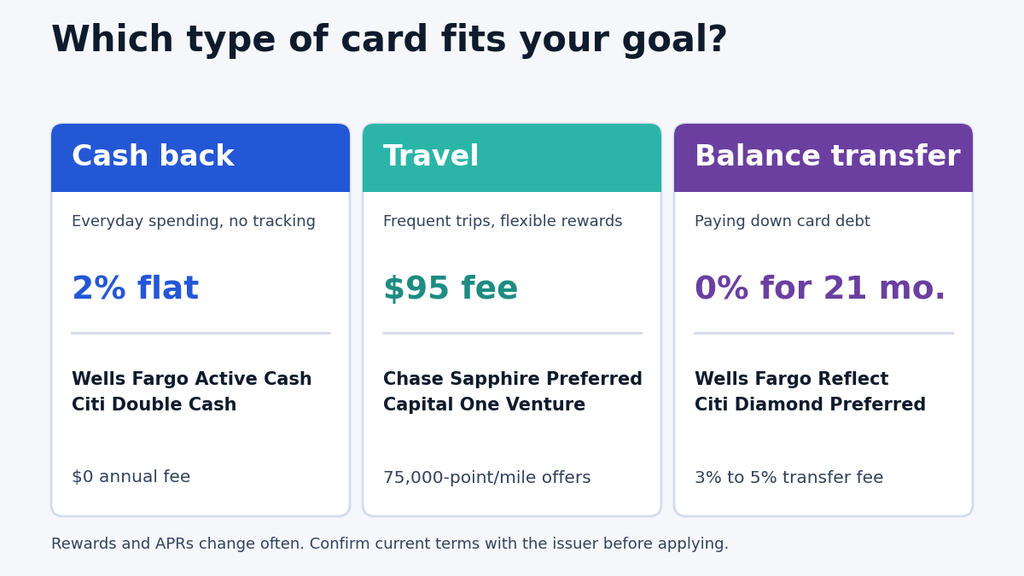
If you pay your statement in full every month, rewards cards make sense. If you carry debt, skip rewards entirely and focus on a balance transfer card first. Interest will wipe out any points you earn.
Best Cashback Cards
Cashback is the simplest reward: you spend, you get a percentage back as cash or statement credit.
Wells Fargo Active Cash. This is the “one card, no homework” option. It pays a flat 2% on every purchase with a $0 annual fee. It’s a strong default for almost anyone with good credit.
Citi Double Cash. It matches the 2% rate in a different way: 1% when you buy and another 1% when you pay the purchase off. There’s no annual fee, and it also offers an 18-month 0% intro APR on balance transfers, which makes it unusually flexible.
Chase Freedom Unlimited. The base rate is a lower 1.5%, but the bonus categories are useful: 5% on travel booked through Chase Travel, and 3% on dining and drugstores. If you spend heavily at restaurants, the math can beat a flat 2% card.
Blue Cash Preferred from American Express. If your household spends a lot on groceries, this card pays 6% at US supermarkets on up to $6,000 a year. It carries an annual fee, so run the numbers: you need enough grocery spending to more than cover the fee compared with a free 2% card.
How to choose: If you hate tracking categories, take a flat 2% card. If your spending is concentrated in groceries or dining, multiply your yearly spending in each category by the card’s rate, subtract the annual fee, and compare.
Best Travel Cards
Travel cards earn points or miles that are worth more when redeemed for flights and hotels. They usually cost more per year, so they only pay off if you use the perks.
Chase Sapphire Preferred. With a $95 annual fee, it’s the most widely recommended mid-tier travel card. It earns 5x on travel booked through Chase Travel, 3x on dining, and 2x on other travel. It also includes a $100 annual hotel credit through Chase Travel, which offsets most of the fee, and points transfer to Chase’s airline and hotel partners. The current welcome offer is 75,000 points after $5,000 in spending within three months.
Capital One Venture Rewards. Also $95 a year, but simpler: 2x miles on everything, with 5x on hotels, vacation rentals, and rental cars booked through Capital One Travel. It also offers a credit toward Global Entry or TSA PreCheck. The current offer is 75,000 miles after $4,000 in spending in three months.
Capital One Venture X. This premium card has a $395 annual fee, but a $300 annual travel credit (for bookings through Capital One Travel) and a 10,000-mile anniversary bonus can bring the effective cost down sharply. Lounge access adds more value for frequent flyers.
Chase Sapphire Reserve. At roughly $795 a year, it’s built for heavy travelers who will use the credits and lounge access. For most people, the $95 cards are the smarter place to start.
A word on welcome bonuses. They’re real money, but only if you can hit the spending requirement through normal purchases. Never spend extra to unlock a bonus.
Best Balance Transfer Cards
A balance transfer moves debt from a high-interest card to a new card with a 0% introductory rate. Done right, every dollar of your payment goes toward the balance instead of interest.
Wells Fargo Reflect. It offers 0% for 21 months from account opening on qualifying balance transfers (made within 120 days), with a 5% transfer fee (minimum $5). There’s no annual fee.
Citi Diamond Preferred. It also offers 21 months at 0% on transfers completed within the first four months, plus 12 months at 0% on purchases. The transfer fee is 3% (minimum $5) in the first four months, then 5%. It earns no rewards, but it’s built for one purpose.
Citi Double Cash and Wells Fargo Active Cash. If you want to keep earning 2% after the payoff, both offer an intro period on transfers (18 months for Double Cash, 15 months for Active Cash according to current listings). The intro period is shorter, but you get a long-term rewards card.
Is it worth the fee?
Here’s an example. Suppose you owe $5,000 at 24.24% APR and pay $300 a month. You’d need about 21 months to clear it and pay roughly $1,158 in interest. On a 0% transfer card, the only cost is the transfer fee.
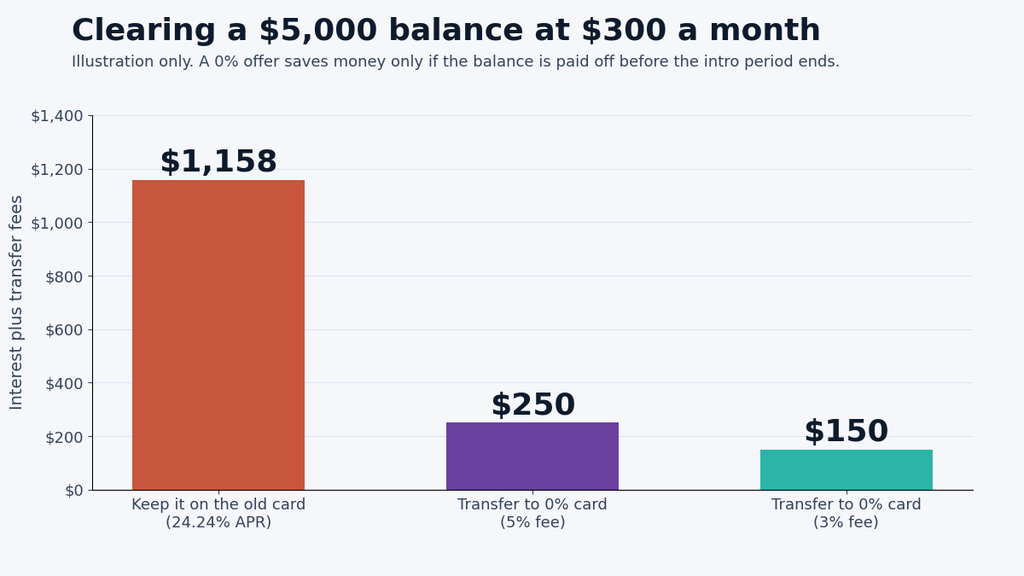
At a 3% fee you’d pay $150, and at 5% you’d pay $250. Either way, the balance is gone in about 18 months, well inside a 21-month window, and you’d save roughly $900 to $1,000. The savings only work if you actually finish paying before the 0% period ends, so divide your balance by the number of promotional months to find your minimum monthly payment.
Mistakes to Avoid
- Carrying a balance on a rewards card. Interest rates near 20% or higher cancel out 2% rewards many times over.
- Missing the transfer deadline. Most offers require transfers within a set window after opening.
- Paying only the minimum. Minimum payments won’t clear the balance before the 0% period ends.
- Applying for many cards at once. Each application can lower your credit score slightly.
- Ignoring the annual fee. A premium card only wins if you use the credits.
Which Card Should You Choose?
- You pay in full and want simplicity: Wells Fargo Active Cash or Citi Double Cash.
- You spend a lot on groceries or dining: Blue Cash Preferred or Chase Freedom Unlimited, after checking the math.
- You travel a few times a year: Chase Sapphire Preferred or Capital One Venture.
- You travel often and want perks: Capital One Venture X.
- You’re paying off debt: Wells Fargo Reflect or Citi Diamond Preferred.
Most of these cards require good to excellent credit, so check your score before applying.
The Bottom Line
Choose the card by the job it needs to do. For most people paying in full, a no-fee 2% card is the best foundation. Add a travel card if you’ll truly use the perks. And if you’re carrying debt, a 0% balance transfer is the card that will save you the most money, as long as you commit to a payoff plan before the intro period ends.
Disclaimer: This article is for general information only and is not financial advice. Card terms, rewards, fees, and APRs change frequently and vary by applicant. Review the issuer’s current terms before applying.
Please wait…
Your Code
This code is fixed and not randomly generated.