US rules · Updated October 2026 · about 7 minute read
Crypto is not tax-free, even though it can feel like internet money. In the United States, the IRS treats cryptocurrency as property, which means that selling or spending it can trigger taxes in much the same way as selling stocks or other investments. This guide explains the basics in plain language so you know what to track and what to report.
Scope: this guide covers US federal tax rules as of October 2026. Other countries tax crypto differently, so if you live elsewhere, check your local tax authority. Rules also change, so confirm current details with the IRS or a tax professional.
The core idea: crypto is property
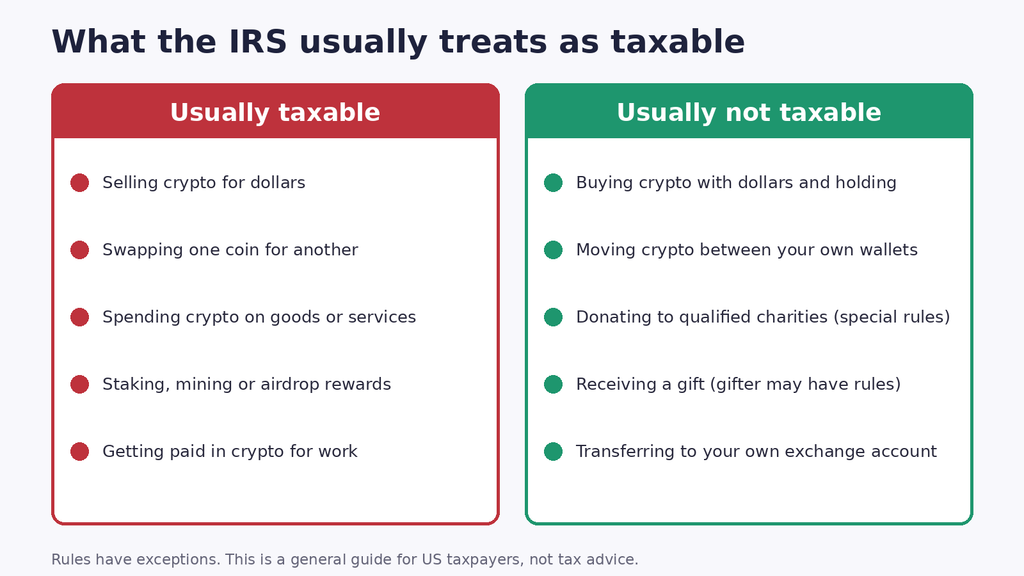
Because crypto is property, you generally owe tax when you dispose of it, not when you simply buy and hold it. A disposal includes selling for dollars, swapping one token for another, or using crypto to pay for something. Each disposal can create a capital gain or loss, which is the difference between what you received and what you originally paid.
Taxable events you might not expect
Many beginners assume tax only applies when they cash out to dollars. In reality, swapping Bitcoin for Ethereum is a taxable disposal of the Bitcoin. Buying a coffee with crypto is a disposal of whatever amount you spent. Each of these requires you to calculate gain or loss based on the value at the time. Fees paid to buy or sell may usually be added to your cost or subtracted from proceeds.
Capital gains versus income
There are two main ways crypto is taxed. The first is capital gains, which apply when you sell or swap an asset you held as an investment. The second is ordinary income, which applies when you receive crypto as a reward or payment. Staking rewards, mining rewards, airdrops and crypto paid for work are generally taxed as income at fair market value when you receive them. That value also becomes your cost basis if you later sell. Freelancers paid in crypto may also owe self-employment tax.
How to calculate a gain or loss
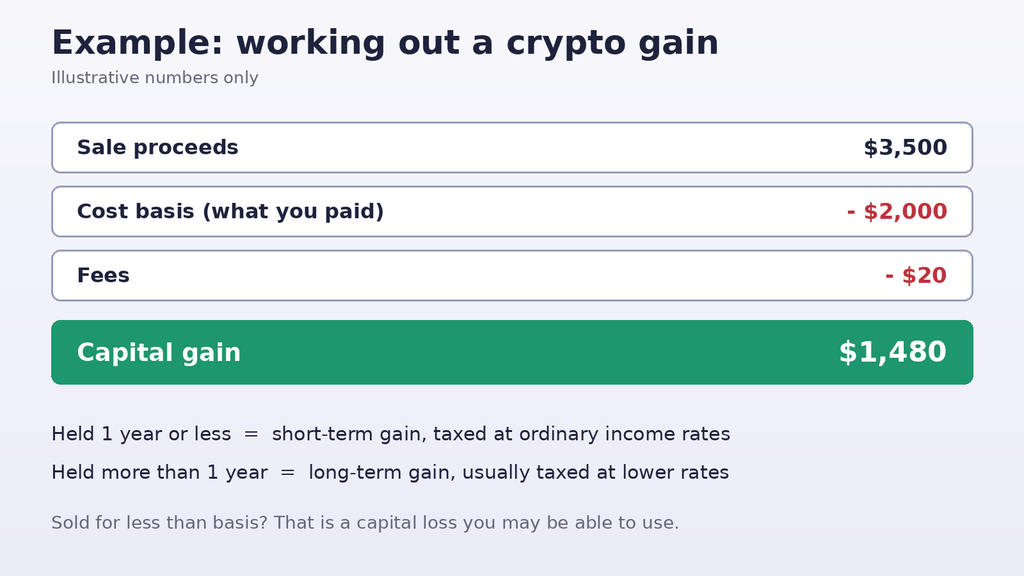
The formula is simple: proceeds minus cost basis, adjusted for fees. Cost basis is what you paid to acquire the asset, including purchase fees. If you sell for more, you have a gain. If you sell for less, you have a loss.
Short-term versus long-term
How long you held the asset matters. If you held it for one year or less, the gain is short-term and taxed at your ordinary income rate. If you held it for more than one year, it is long-term and usually taxed at lower rates, which depend on your total income. Holding a profitable position just past the one-year mark can reduce your tax bill, but never let tax alone drive an investment decision.
The new reporting rules you should know
US reporting has tightened. Brokers, including many centralized exchanges, now issue a new form, Form 1099-DA, that reports your crypto sales to you and the IRS. For 2025 transactions, brokers were required to report gross proceeds. For transactions starting in 2026, they must also report cost basis for certain assets, mainly those you acquired and held at that broker. Forms generally arrive by mid-February.
The catch is that cost basis is often missing or wrong, especially for coins you transferred in from another wallet or exchange. If you do not correct it, the IRS may treat the full sale amount as profit. Always compare your 1099-DA with your own records before filing.
Wallet-by-wallet tracking
The IRS now expects you to track cost basis wallet by wallet or account by account, instead of pooling everything together. If you hold crypto on an exchange and in a hardware wallet, each is its own bucket of cost-basis records. Keep clear records of where each purchase was made and where each sale occurred.
Losses and tax-loss harvesting
Capital losses can offset capital gains, and if losses exceed gains you can generally deduct a limited amount against other income each year, carrying the rest forward. The wash sale rule that blocks quick repurchases for stocks does not currently apply to crypto, but rules can change and strategies that lack real economic substance can attract scrutiny. Talk to a professional before building a strategy around this.
Records you need to keep
- Date and time of each purchase, sale, swap or payment.
- The amount, the asset and its dollar value at the time.
- Fees paid and which wallet or exchange was used.
- Records of income from staking, mining, airdrops or work.
- Transfer records between your own wallets, to show they were not sales.
How to report on your return
- Answer the digital asset question on Form 1040 honestly.
- Gather your 1099-DA forms and exchange or wallet histories.
- Calculate gains and losses and report them on the forms for capital gains.
- Report crypto income, such as staking rewards, as income.
- Correct any wrong or missing cost basis with supporting records.
- Consider crypto tax software or a tax professional for complex activity.
NFTs, DeFi and other special cases
NFT sales, trading on decentralized exchanges, lending and liquidity pools are generally treated under the same property principles, but they can be more complicated. Many on-chain actions will not appear on any exchange form, so you are responsible for tracking them. Wrapping, bridging and providing liquidity can raise unsettled questions, so get professional advice if you do more than occasional trades. Gifts and inheritances also have their own rules for basis and reporting.
Do you need crypto tax software?
If you made a handful of trades on one exchange, a spreadsheet may be enough. If you use several exchanges, wallets or DeFi apps, software can import transaction histories and calculate gains wallet by wallet. Check that it supports your platforms, review its output instead of trusting it blindly, and keep exports as backup. A tax professional familiar with digital assets can help with unusual situations.
What if you did not report in the past?
Unreported crypto income and gains can lead to back taxes, interest and penalties. If you missed earlier years, speak to a qualified tax professional about amending returns. Fixing it voluntarily is generally better than waiting for an IRS notice, and with exchange reporting now stronger, mismatches are easier for the IRS to spot.
Common beginner mistakes
- Thinking crypto-to-crypto swaps are not taxable.
- Ignoring staking, airdrop or mining income because no sale occurred.
- Failing to track cost basis, leading to overpaying tax.
- Relying only on the exchange form, which may miss DeFi, NFT or wallet activity.
- Treating transfers between your own wallets as sales, or not documenting them.
- Waiting until tax day to reconstruct years of transactions.
Good records and early planning make crypto taxes manageable. Track as you go, check your forms and consider professional help once your activity grows.
General information only, not tax or legal advice. Tax rules change and your situation may differ; confirm current requirements with the IRS or a qualified tax professional.
Please wait…
Your Code
This code is fixed and not randomly generated.