US guide · Updated October 2026 · about 7 minute read
As a freelancer, nobody withholds taxes from your pay, so the job of calculating, saving and filing falls to you. That is not as frightening as it sounds once you understand the few moving parts: how your income is reported, which expenses you can deduct, how self-employment tax works and when payments are due. This guide covers the basics for US freelancers.
Scope: this is US federal tax information as of October 2026. State rules, other countries and your personal circumstances differ, so confirm details with the IRS or a tax professional.
How freelancer taxes work
Freelancers pay two kinds of federal tax on their profit. The first is regular income tax at your bracket. The second is self-employment (SE) tax, which funds Social Security and Medicare. It is 15.3% in total: 12.4% for Social Security up to an annual wage cap ($184,500 for 2026) and 2.9% for Medicare with no cap. It applies once your net self-employment earnings reach $400 for the year. Employees only see half of this because their employer pays the other half.
SE tax is calculated on 92.35% of your net profit. As an example, with $60,000 of net profit, about $55,410 is taxed at 15.3%, which comes to roughly $8,478. You can deduct half of that SE tax when figuring your income tax.
Do you get a 1099?
Clients who pay you $2,000 or more in 2026 should send a Form 1099-NEC, up from the old $600 threshold. Payment platforms may send a 1099-K above certain thresholds. But a missing form changes nothing about your duty: you must report all freelance income, whether or not you receive a form.
The forms you will use
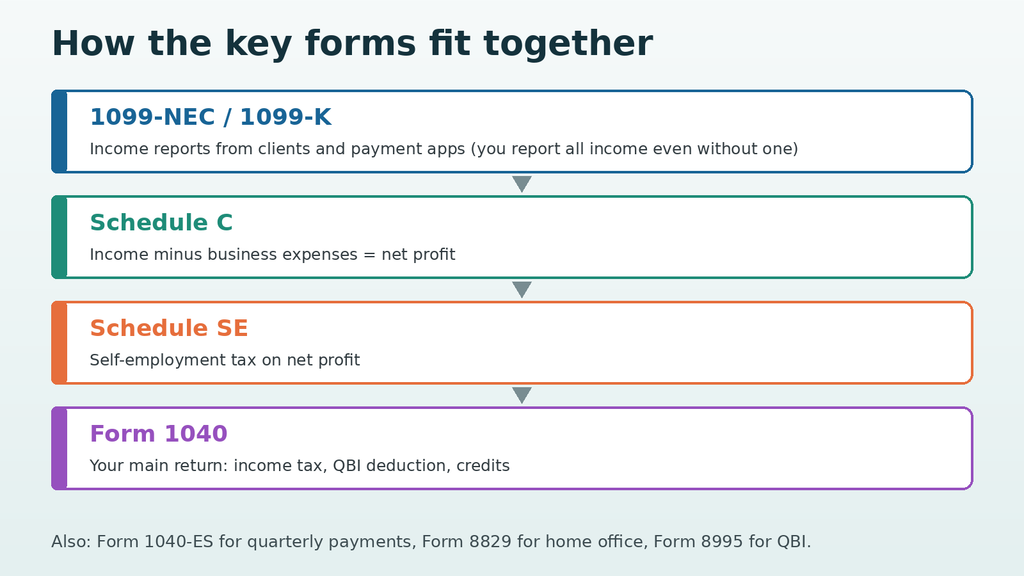
- Schedule C: reports your freelance income and business expenses. The result is your net profit.
- Schedule SE: calculates self-employment tax from that net profit.
- Form 1040 and Schedule 1: your main return, where business profit and certain deductions flow through.
- Form 1040-ES: used to calculate and pay quarterly estimated taxes.
- Form 8829: the regular method for the home office deduction.
- Form 8995: used to claim the qualified business income (QBI) deduction.
Deductions freelancers commonly claim
Every legitimate business expense lowers both your income tax and your SE tax. The expense must be ordinary and necessary for your work, and you must be able to document it.
- Home office: if you use part of your home regularly and exclusively for business, you can deduct a share of costs, or use the simplified method based on square footage.
- Equipment and software: computers, cameras, subscriptions and tools used for work.
- Internet and phone: the business-use percentage.
- Business travel and vehicle use: keep a mileage log and check the IRS standard mileage rate.
- Marketing and professional costs: websites, ads, accounting, legal fees and training related to your work.
- Business meals: generally 50% deductible when business related.
- Self-employed health insurance: premiums may be deductible if you qualify.
- Retirement contributions: a SEP-IRA or Solo 401(k) can reduce taxable income, within annual limits.
The QBI deduction
Many freelancers can deduct up to 20% of their qualified business income. The deduction was made permanent by 2025 legislation. It reduces your income tax, not your SE tax, and limits apply at higher incomes and for certain service fields. A tax professional can confirm whether you qualify and how much you can claim.
Quarterly estimated taxes
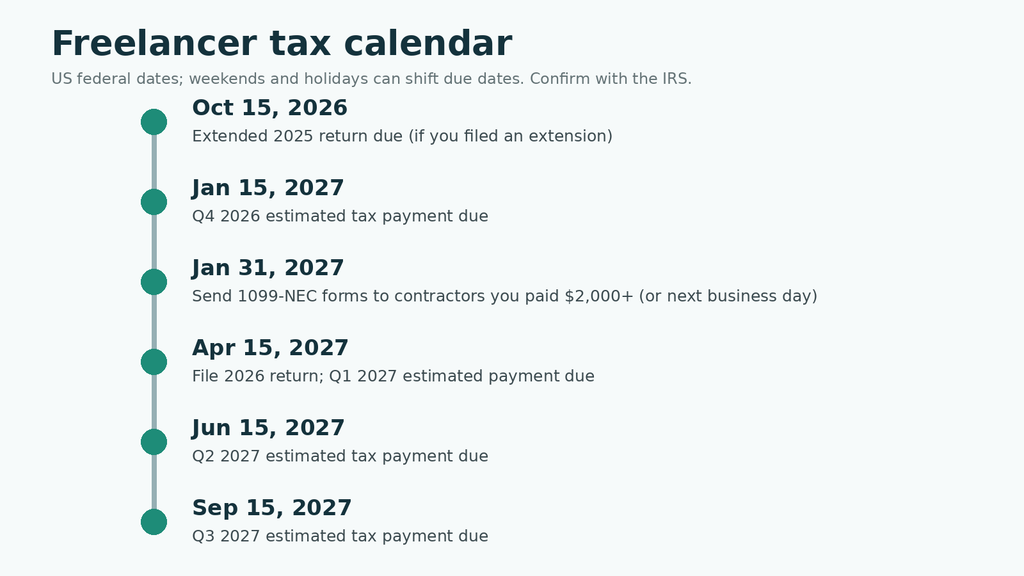
Because no one withholds tax for you, you generally need to make estimated payments if you expect to owe $1,000 or more for the year. The four dates fall in April, June, September and January. To avoid underpayment penalties, many freelancers aim to pay at least 90% of this year’s tax or 100% of last year’s tax (110% for higher earners). Setting aside a share of every payment as it arrives is the simplest habit. Many people save roughly 25% to 30% of income for federal taxes, but your rate depends on your income and state.
Keep clean records
Use a separate bank account and card for business, track income and expenses monthly and save receipts digitally. Keep records for at least three years, or longer in some situations. Accounting software or a simple spreadsheet works. Good records make filing faster and defend your deductions if the IRS asks questions.
State taxes and other obligations
Most states tax income, and a few charge extra fees or require business licenses. If you sell products or certain services, you may need to collect sales tax. If you work from another state or country, the rules can get complicated. Check your state revenue department’s website.
Mistakes to avoid
- Forgetting self-employment tax when budgeting.
- Skipping quarterly payments and getting hit with penalties.
- Mixing personal and business spending.
- Claiming expenses without receipts or a clear business reason.
- Assuming no 1099 means no taxable income.
- Waiting until April to organize a year of records.
- Overstating the home office deduction.
Your filing checklist
- Collect all 1099 forms and your own income records.
- Total your business expenses by category.
- Complete Schedule C to find your net profit.
- Calculate SE tax on Schedule SE and take the half deduction.
- Claim the QBI deduction and other eligible deductions.
- Reconcile estimated payments already made.
- File on time, or file for an extension and still pay what you owe.
An extension gives you more time to file, not more time to pay. If your income is growing or complex, a tax professional can often save more than they cost.
General information only, not tax or legal advice. Tax laws, thresholds and deadlines change and your situation may differ; confirm current rules with the IRS or a qualified tax professional.
Please wait…
Your Code
This code is fixed and not randomly generated.