Updated October 2026 · about 7 minute read
Choosing your first crypto exchange matters. It decides how much you pay in fees, how easy buying feels and, most importantly, how safe your money is. This guide compares well-known exchanges on fees and safety, and shows what to check before you deposit.
Accuracy note: I compared several recent 2026 reviews, and their fee figures often disagree because exchanges charge different amounts by product, payment method and trading volume. So I use approximate ranges, not exact rates. Availability also depends on your country or US state. Confirm current fees and eligibility on each exchange’s own site. This is general information, not investment advice, and crypto prices can fall sharply.
How exchange fees work
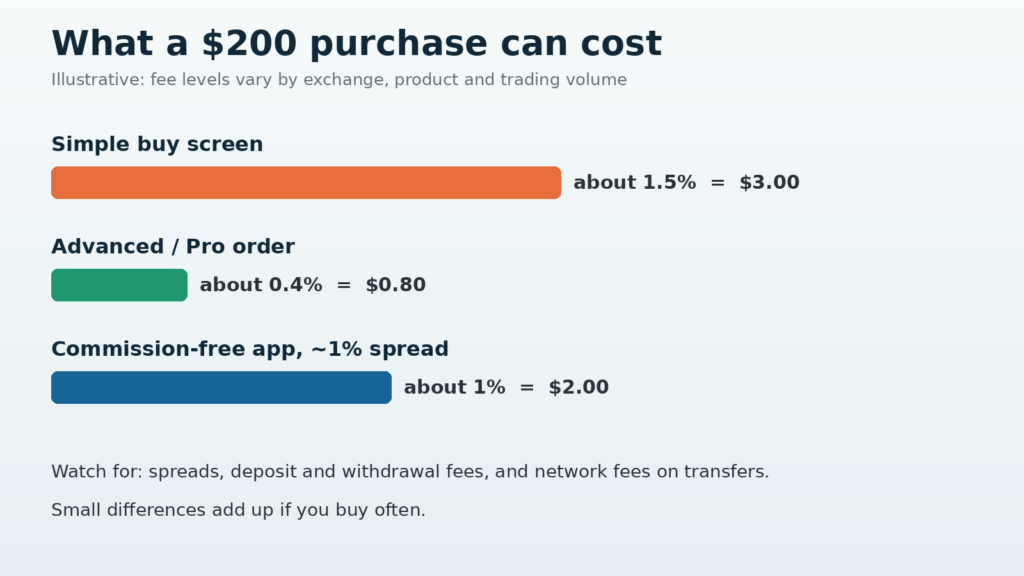
Most exchanges earn money in several ways. A trading fee is a percentage of each trade. A spread is the gap between the buying and selling price, which can hide a cost even when the app says “no fees”. Some charge a convenience fee for card purchases or the simple buy screen, deposit or withdrawal fees, and you also pay network fees when you send crypto out to a wallet. The simplest screen in an app is almost always the most expensive, while the advanced or pro screen is cheaper but looks more complicated.
How to judge exchange safety
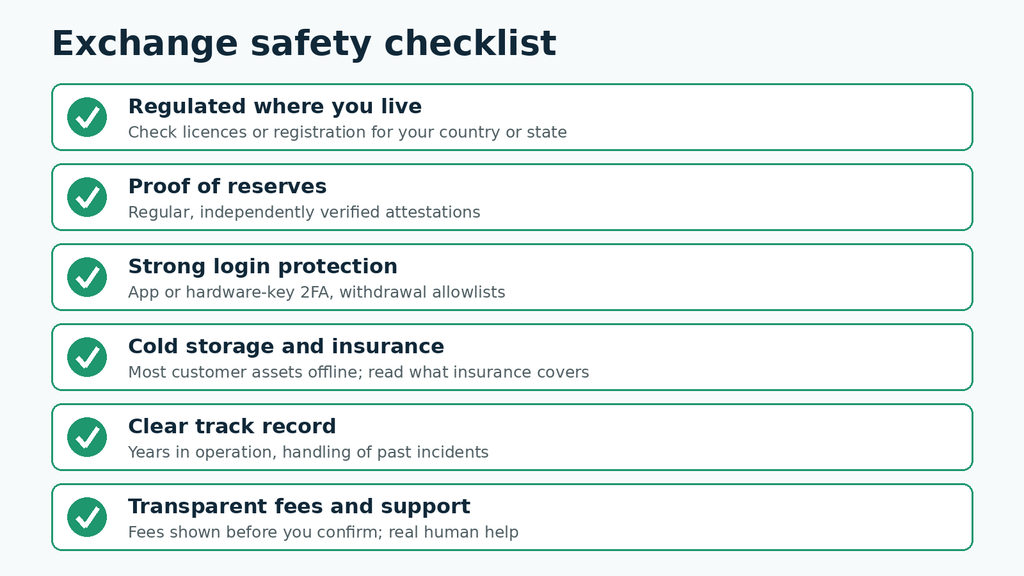
No exchange is risk-free. Past failures, including FTX in 2022 and Mt. Gox earlier, show that customers can lose money when an exchange is badly run or dishonest. When you leave coins on an exchange, you trust the company to hold them. Look for clear regulation where you live, a long track record, strong account protection and transparent practices.
7 crypto exchanges compared
1. Coinbase
Best for: easiest first purchase.
Coinbase is the most beginner-friendly option in most reviews, with a simple app, guided onboarding and wide availability. It is a publicly traded US company. The trade-off is cost: the simple buy screen is typically the most expensive way to trade, with total fees reported anywhere from about 1% to several percent depending on payment method and amount. The Advanced platform is cheaper.
2. Kraken
Best for: lower fees and a long security record.
Kraken has operated since 2011 and publishes regular proof-of-reserves attestations. Its Pro platform has some of the lower fees among US-available exchanges, with base-tier fees often cited around 0.25% to 0.40%, while its simple buy screen costs more. The interface is a bit busier than Coinbase, so many beginners start simple and move to Pro later.
3. Gemini
Best for: compliance-focused users.
Gemini is regulated in New York and emphasizes security and compliance, with independent security audits. Its simple buy mode can cost around 1.5% or more when its fees are combined, and the ActiveTrader platform is cheaper but not the lowest. It supports fewer coins than Kraken or Coinbase.
4. Robinhood
Best for: people who already invest in stocks.
Robinhood lets you buy crypto next to stocks with no commission, but it earns money from the spread between buying and selling prices. It supports fewer coins than the bigger exchanges. It is a convenient single-app option if you want a simple purchase and not much else.
5. Binance and Binance.US
Best for: broad selection and low headline fees, outside the US.
The global Binance platform lists a very large number of coins with low headline fees, but US residents cannot use it. Binance.US is a separate platform with a smaller selection. Availability, features and rules vary a lot by country, so check what is legal and offered where you live.
6. Crypto.com
Best for: people who like a broad app ecosystem.
Crypto.com offers an app with trading, a card and rewards features. Fees and promotions vary, and some rewards depend on locking up its native token, which adds risk. Beginners should read the fee screen carefully and avoid unnecessary extras.
7. Bitstamp
Best for: straightforward spot trading.
Bitstamp is one of the older exchanges and now sits under Robinhood. It focuses on simple spot trading and suits people who want fewer features. Check current fees and availability in your region, as they change.
Which one should you choose?
If you want the easiest first purchase and accept higher fees, Coinbase is the usual pick. If you want lower costs and are willing to learn a slightly more detailed screen, Kraken is a popular next step. If you already use Robinhood for stocks, its simplicity may suit small purchases. Gemini suits people who put compliance first. Outside the US, you will have more choices, but check local rules and whether the exchange is licensed for your country.
Protect your account
- Use a unique, strong password and a password manager.
- Turn on two-factor authentication using an authenticator app or a hardware key, not SMS where possible.
- Enable withdrawal address allowlists and security alerts.
- Beware of phishing emails, fake support accounts and fake apps. Type the exchange address yourself.
- Never share recovery phrases, and never give anyone remote access to your device.
Exchange or your own wallet?
Exchanges are convenient, but leaving large amounts there means you rely on the company. Many people keep only what they plan to trade on an exchange and move long-term holdings to a wallet they control, such as a hardware wallet. That adds responsibility: if you lose your recovery phrase, nobody can restore your coins. Start small and practice with a minor amount first.
Beginner mistakes to avoid
- Using only the simple buy screen for large or frequent purchases.
- Choosing an exchange because of a sign-up bonus, without checking fees or reputation.
- Depositing more than you can afford to lose.
- Trusting offshore platforms that are not licensed where you live.
- Ignoring tax record keeping. Download your transaction history regularly.
- Falling for “guaranteed return” or giveaway scams.
Getting started step by step
- Shortlist two exchanges available in your location.
- Read the fee page and check regulation and security details.
- Create your account, complete identity verification and turn on strong 2FA.
- Make a small first purchase to learn the process.
- Review the fee you paid, then decide whether to use a cheaper screen.
A good beginner exchange is one that is legal where you live, clear about fees and trustworthy with your money. Take your time and start small.
General information only, not financial advice. Crypto is volatile and can lose value; fees, features and availability change often and vary by location. Verify details on each exchange’s website.
Please wait…
Your Code
This code is fixed and not randomly generated.