
A practical guide · about 8 minute read
AI tools have made it faster to write, design, code, analyze and automate. They have not made money automatic. The people who earn with them usually solve a business problem, use AI to deliver faster, and add judgment that the software lacks. “Proven” here means methods that real freelancers and small agencies use, not guaranteed income. Results depend on your skill, niche and effort.
The principle behind every method
AI lowers the cost of producing a first draft. So the value shifts to knowing what to produce, checking that it is correct, and delivering it reliably. Clients rarely care which tool you used. They care that the work is accurate, on time and useful. If your only skill is typing prompts, you will compete with everyone. If you pair AI with a specific skill or industry, you stand out.
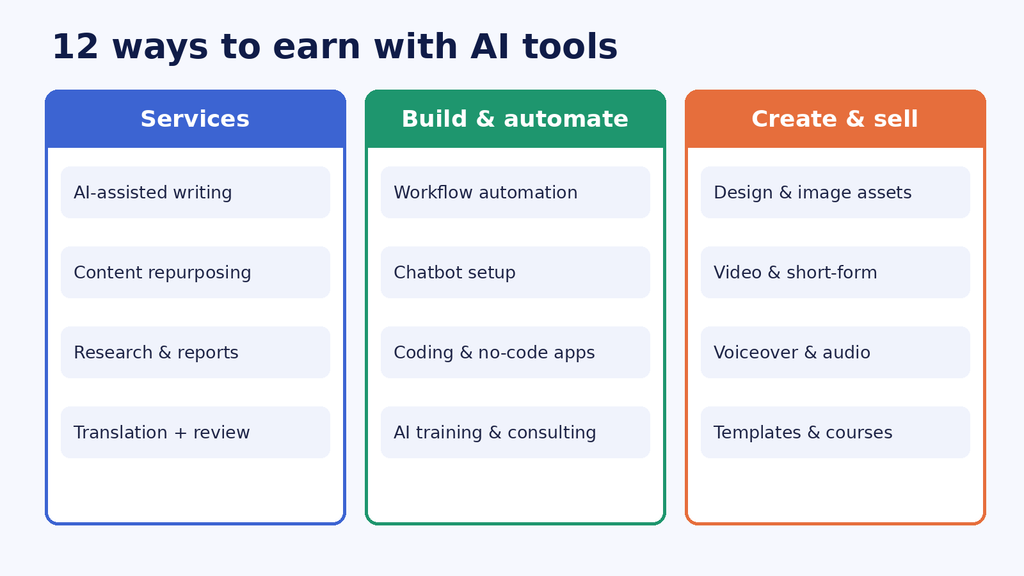
12 ways to make money with AI tools
1. AI-assisted writing and editing
Use AI to speed up research, outlines and first drafts, then edit heavily so the voice, facts and structure are yours. Clients pay for quality and accuracy. Specialize in a niche, such as software or health, and always verify claims before delivering.
2. Content repurposing
Turn one webinar, podcast or article into newsletters, social posts, summaries and short scripts. Businesses with lots of content but little time pay monthly fees for this. AI handles the first pass and you handle taste and consistency.
3. Research and report services
Summarizing documents, comparing vendors and preparing briefings is time-consuming work. AI can speed it up, but check sources yourself. Deliver clear, cited, decision-ready reports for founders, consultants and agencies.
4. Translation and localization
AI gives a strong starting translation, and a fluent human makes it natural and culturally correct. Offer website, product-description and marketing localization, especially in language pairs where you are fluent.
5. Workflow automation
Many small businesses repeat the same steps daily: lead follow-ups, invoice sorting, appointment reminders. Connect tools with no-code automation platforms and AI steps. Start with one narrow problem and charge for the time saved.
6. Chatbot and support setup
Companies want assistants that answer common questions on their site. Build one trained on their approved information, test it for wrong answers, and set up a path to a human. Offer setup plus a monthly maintenance fee.
7. Coding and no-code apps
AI coding assistants help beginners and experts build scripts, internal tools, landing pages and simple apps faster. Sell small custom tools to local businesses. Review the code, test it and be honest about limitations.
8. AI training and consulting
Teams are unsure how to use these tools safely. Run workshops, write usage guidelines and show people how to apply AI to their own tasks. Professionals with industry experience are especially credible here.
9. Design and image assets
AI image tools can create concepts, social graphics, mockups and product visuals. Read each platform’s rules, because some marketplaces restrict or require disclosure of AI work, and avoid copying living artists’ styles or protected characters.
10. Video and short-form production
Combine AI for scripts, captions, clipping and editing support with your own judgment. Creators and brands pay for steady output of short videos. Consistency and good hooks matter more than fancy effects.
11. Voiceover and audio editing
AI tools can clean audio, remove filler words and help prepare voiceovers. Offer podcast editing, show notes and audio cleanup. Use synthetic voices only with proper permission and clear client approval.
12. Templates, prompt packs and courses
Digital products can scale, but this space is crowded. A generic prompt pack rarely sells. A specific template set or short course for one profession, such as real estate agents or accountants, has a better chance.
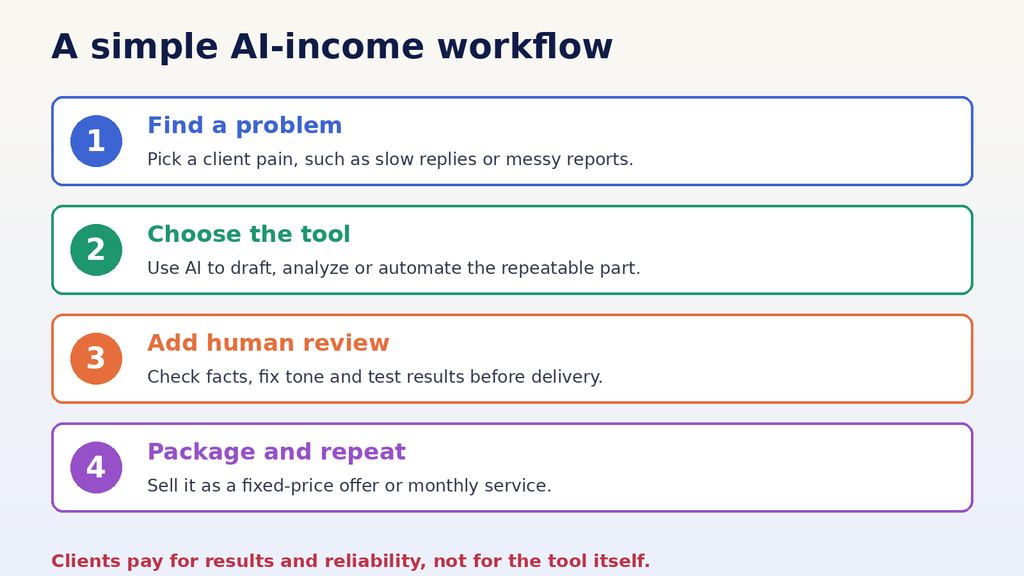
A workflow that turns tools into income
Most successful AI-based services follow the same loop. Find a specific problem, choose the right tool, review the output carefully and package the result as a repeatable offer. This is how a one-off task becomes a monthly client.
Rules that protect you and your clients
- Verify everything. AI can state wrong facts confidently. Check names, numbers and sources before delivery.
- Protect confidentiality. Do not paste client secrets or personal data into tools without permission and a clear understanding of how the tool handles data.
- Follow platform and client rules. Some marketplaces, publishers and employers limit or require disclosure of AI use.
- Respect copyright and likeness. Avoid copying protected works, brand assets or someone’s voice or face without consent.
- Be honest. Tell clients how you use AI when it matters to them, and never promise results you cannot control.
How to pick your first method
Start with what you already know. An accountant can offer AI-assisted bookkeeping reports. A teacher can create lesson materials and tutoring. A marketer can offer content repurposing. Choose the option closest to your experience, because credibility beats novelty. Then test it on one or two real clients at a reduced rate to learn what works.
How to price and find clients
Price by outcome rather than hours. If AI helps you finish in two hours what used to take eight, charging by the hour punishes you for being efficient. Offer fixed packages, such as five weekly posts for a set price, or a monthly retainer. Find clients through LinkedIn, local business groups, freelance marketplaces and referrals. A short demo showing before-and-after results is more persuasive than a long pitch.
What to expect from your income
Be wary of anyone promising passive income with a single prompt. Most people who earn with AI do so through services, because clients pay for finished work. Expect your first month to go into learning, samples and outreach. Income tends to grow once you have a few testimonials and a clear niche. Product-based methods can scale, but usually take longer and carry more risk. Track your time and earnings, and keep the methods that pay best per hour.
Common mistakes
- Selling the tool instead of the result.
- Delivering unedited AI output that sounds generic or contains errors.
- Chasing every new tool instead of mastering a few.
- Entering saturated markets with undifferentiated products.
- Skipping contracts that explain scope, ownership and AI usage.
Your 30-day starter plan
- Week 1: Choose one method and one niche, and test two or three tools.
- Week 2: Create sample work and a simple before-and-after demo.
- Week 3: Contact 10 prospects a day with a specific offer.
- Week 4: Deliver pilot projects, ask for testimonials and set your packages.
The opportunity is real, but it favors people who combine tools with skill, care and consistency. Pick one lane, deliver reliably and improve each month.
General information only, not financial or legal advice. Earnings are not guaranteed; tools, platform rules and laws around AI change quickly, so check current terms.
Please wait…
Your Code
This code is fixed and not randomly generated.