A US guide · Updated October 2026 · about 7 minute read
A limited liability company, or LLC, is one of the most popular ways for US small businesses to separate personal and business assets, with simpler paperwork than a corporation. The process is similar everywhere, but fees, rules and deadlines vary by state. This guide covers the steps, what it costs and the mistakes that cause real trouble later.
A note on accuracy: I compared several current 2026 fee tables, and they sometimes disagree on details. The figures below are approximate, so confirm the exact numbers on your state’s Secretary of State or business filing website before you pay.
What an LLC does, and does not, do
An LLC generally protects your personal assets, such as your home and savings, from business debts and lawsuits against the company. It does not protect you from your own negligence, personal guarantees or fraud. By default, a single-member LLC is taxed as a sole proprietorship and a multi-member LLC as a partnership, so profits pass through to your personal tax return. You may later elect to be taxed as an S corporation if that suits your finances. Ask a tax professional before choosing.
The 7 steps to form an LLC
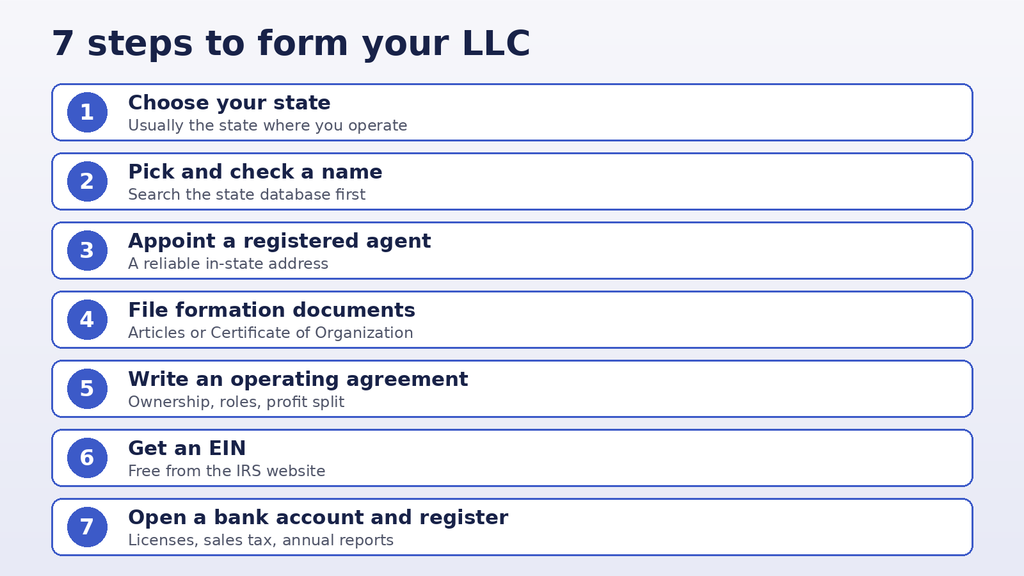
1. Choose your state
Most small businesses should form in the state where they live and operate. Forming elsewhere, such as Delaware or Wyoming, usually means paying two states, because you must also register as a foreign LLC where you actually do business. Compare filing fees, annual costs, taxes and rules, but do not choose a state only because of marketing hype.
2. Pick a name and check availability
Search the Secretary of State’s business database to see whether your name is taken or too similar to another. Most states require the name to include “LLC” or a similar designator. Check trademarks and available domain names too. Some states let you reserve a name for a small fee.
3. Appoint a registered agent
Every LLC needs a registered agent with a physical address in the state to receive legal papers and official notices. You can serve as your own agent if you are available during business hours, or hire a service, which commonly costs roughly $50 to $300 a year. Costs vary, so compare providers.
4. File your formation documents
This is the document that legally creates your LLC. It is called Articles of Organization in most states and Certificate of Formation or Organization in others. File online if possible. Fees run from about $40 to $500, and processing can take from same-day to several weeks depending on the state.
5. Create an operating agreement
Many states do not require one, but you should have it anyway. It sets out ownership percentages, roles, how profits are split, what happens if a member leaves and how decisions are made. Banks often ask for it, and it strengthens your liability protection.
6. Get an EIN
An Employer Identification Number identifies your business for taxes, banking and hiring. Apply directly on the IRS website. It is free, and you should be cautious of sites that charge for it.
7. Open a bank account and register
Open a business bank account and keep business money separate from personal funds. Then check what licenses, permits and sales tax registrations your city, county, state and industry require. Put annual report deadlines on your calendar immediately.
How much does it cost?
The filing fee is only the start. Many states also charge annual or biennial reports, and a few add franchise taxes or business license fees. Filing fees across states range from roughly $35 to $500, and total first-year state costs can exceed $1,000 in the most expensive places. The chart below compares a selection of states.
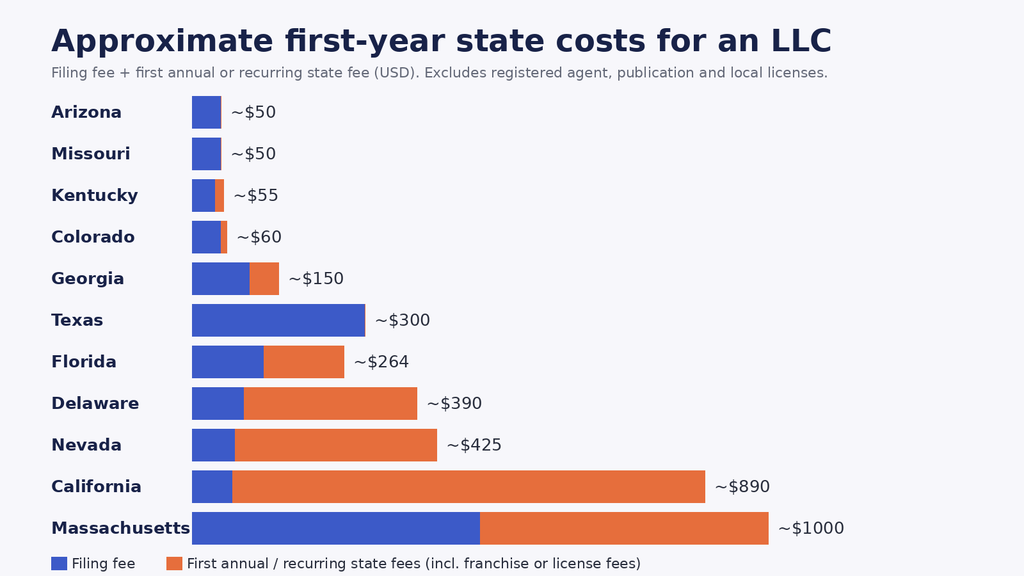
A few patterns stand out. Arizona, Missouri and several other states have low costs and little or no ongoing fee. California charges a minimum annual franchise tax of $800, which makes it expensive even with a low filing fee. Massachusetts has high filing and annual report fees. Nevada and Delaware are often promoted as business-friendly, but they carry significant yearly costs. Remember to add a registered agent, any required newspaper publication, and local licenses to your budget. Some states, including New York and Arizona, have publication requirements that can add a lot to the total.
Ongoing compliance
Forming the LLC is not the end. Most states require annual or biennial reports, and missing a deadline can bring late fees, loss of good standing or administrative dissolution. Keep your registered agent details current, file taxes on time, and keep a record of important decisions and agreements. Federal rules on beneficial ownership reporting have changed several times in recent years, so check the current requirements with FinCEN or a professional.
Mistakes to avoid
- Picking a state for hype. If you operate at home, forming in another state often just doubles fees and paperwork.
- Skipping the operating agreement. Without one, state default rules decide disputes, and they may not match what you intended.
- Mixing personal and business money. Commingling funds can weaken liability protection. Use a separate account and pay yourself properly.
- Missing annual reports and fees. This is a common way LLCs lose good standing.
- Paying for a free EIN. The IRS issues them at no charge.
- Ignoring licenses and sales tax. Forming an LLC does not replace local permits or tax registrations.
- Assuming total protection. Personal guarantees on loans and leases, and your own wrongdoing, can still make you personally liable.
- Using the wrong address. Your registered agent address must be reliable, or you may miss legal notices.
Do you need a lawyer or a service?
You can form an LLC yourself using your state’s website, and most states make it straightforward. Online formation services add convenience but charge fees on top of the state fee, and some upsell extras you may not need. Consider a lawyer or accountant if you have several owners, plan to raise money, own significant assets or face complex tax questions.
Quick checklist
- Compare costs and rules, and choose your state.
- Check the name, then reserve it if needed.
- Arrange a registered agent.
- File your formation document and save the approved copy.
- Sign an operating agreement.
- Get a free EIN from the IRS.
- Open a business bank account, register for licenses and taxes, and calendar every deadline.
General information only, not legal or tax advice. Fees, rules and deadlines vary by state and change often; confirm details with your state’s official filing office or a qualified professional.
Please wait…
Your Code
This code is fixed and not randomly generated.