Home insurance premiums have climbed sharply in many regions, but most homeowners accept each renewal notice without a fight. That is a costly habit. A mix of smarter shopping, policy tweaks and modest home upgrades can realistically cut a premium by 30% or more. No single trick does it alone. The savings stack.
Here are seven steps, in the order that usually delivers the biggest return for the least effort.
1. Understand what you are actually paying for
Your premium reflects three things: the cost to rebuild your home, the likelihood of a claim, and the insurer’s own pricing model. You control more of the second factor than you might think, and you can influence the first and third by shopping and by checking your details.
Start by pulling your declarations page. Confirm the dwelling coverage amount, deductible, liability limit, endorsements and any listed upgrades. Errors here are common: a wrong square footage, an outdated roof age, or a feature you no longer have can quietly inflate your price.
2. Shop around every year
This is the single largest lever. Insurers weigh the same risk factors differently, so identical homes can receive quotes that differ by hundreds or even thousands of dollars. Many companies also raise rates for existing customers over time while offering their best prices to newcomers.
Get at least five quotes, using identical coverage amounts and deductibles so the comparison is fair. Include a mix of national carriers, regional insurers and an independent broker who can query several companies at once. Many homeowners find savings of 10% to 25% from this step alone. Once you find a better price, call your current insurer and ask whether it will match it.
3. Raise your deductible, but sensibly
The deductible is what you pay out of pocket before coverage applies. Raising it from $500 to $1,000 can reduce your premium noticeably, and moving to $2,500 can cut it further. The insurer takes on less small-claim risk, and passes some of that benefit to you.
The rule is simple: only choose a deductible you could pay tomorrow without borrowing. Put the premium savings into an emergency fund earmarked for home repairs. Over a few claim-free years, the savings often exceed the extra amount you would pay if you ever filed. Also check whether your policy has a separate, higher deductible for wind, hail or hurricane damage, since that can change the math.
4. Bundle policies, then test the bundle
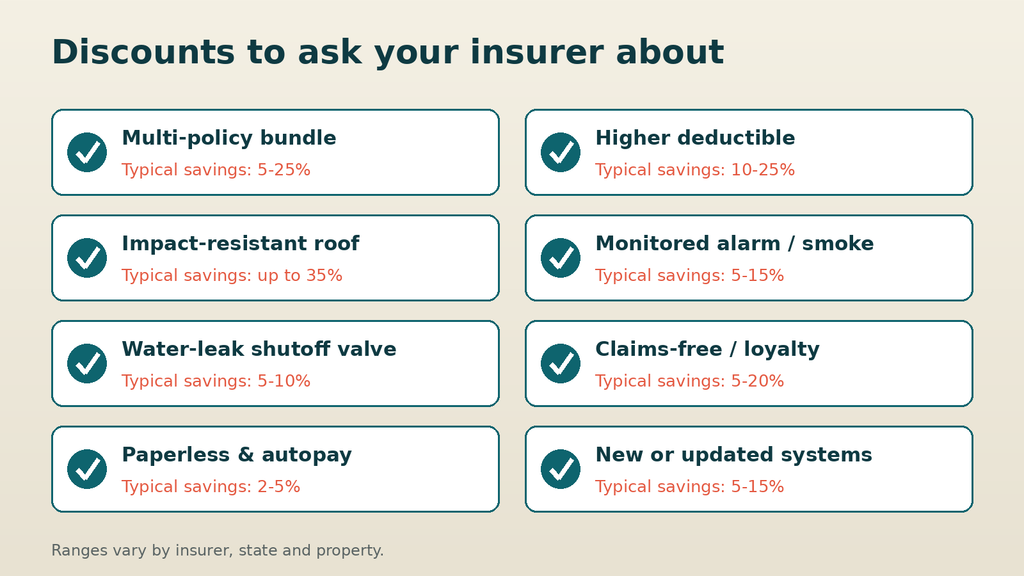
Combining home and auto insurance with one company typically earns a multi-policy discount, often 5% to 25%. Adding an umbrella policy or a valuables policy can improve the discount further.
The catch is that a bundle is not automatically cheapest. Compare the combined bundle price against separate best-price policies. Sometimes a standalone home policy from one insurer and an auto policy from another beats the bundled offer. Do the arithmetic rather than assuming.
5. Make your home harder to damage
Insurers pay for damage, so they reward homes that resist it. The most valuable upgrades depend on your local hazards.
- Roof: A newer roof, or an impact-resistant or wind-rated one, can bring substantial discounts in hail and storm regions. Some insurers also surcharge older roofs, so replacing one can remove that penalty.
- Water protection: Water damage is among the most frequent claims. Replacing aging supply hoses, updating old plumbing and installing an automatic shutoff valve or leak sensors can earn credits.
- Wiring and heating: Updated electrical panels and modern heating systems reduce fire risk, and many insurers price this in.
- Wildfire and wind mitigation: Clearing vegetation, using ember-resistant vents, and adding storm shutters or reinforced garage doors can qualify for mitigation discounts. In some places, an inspection report is needed to claim them.
Ask your insurer which upgrades it recognizes before you spend money. A costly project is worth it only if it moves the price enough or protects you from a real risk.
6. Add security and smart-home devices
Burglar alarms, deadbolts, smoke and carbon monoxide detectors, and fire sprinklers all lower risk. A centrally monitored alarm usually earns a larger credit than one that only sounds locally. Smart water sensors and connected smoke detectors are increasingly accepted as well, and some insurers offer free or discounted devices to policyholders.
Gather receipts or monitoring certificates, because insurers often ask for proof. The credit might be modest on its own, often 5% to 15% across several devices, but it adds to your other savings.
7. Ask for every discount, and keep your record clean
Discounts are rarely applied automatically. Call and ask about all of them. Common ones include loyalty, claims-free, paperless billing, autopay, paying annually instead of monthly, retiree status, new-home credit, and affiliations with employers, alumni groups or professional associations.
Your claims history and, in most US states, your credit-based insurance score also affect price. Paying bills on time, keeping credit card balances low and correcting errors on your credit report can help over time. Think carefully before filing small claims. Several minor claims can raise your rate or lead to non-renewal, so it can be cheaper to absorb a $700 repair yourself.
A caution on overinsuring and underinsuring
Do not cut your premium by shaving the wrong coverage. Dwelling coverage should reflect the cost to rebuild, not the market value or purchase price, and rebuild costs can change quickly. Dropping to a lower figure saves money until you need the payout. On the other hand, you also should not pay for coverage you cannot use. The land under your house is not insured, so excluding it from the coverage amount is reasonable.
Review your liability limit, personal property coverage and endorsements for flood or earthquake, since standard policies usually exclude those hazards. Choose replacement cost for contents if you can afford it. A 30% saving is only a win if the policy still protects you.
What 30% can look like in practice
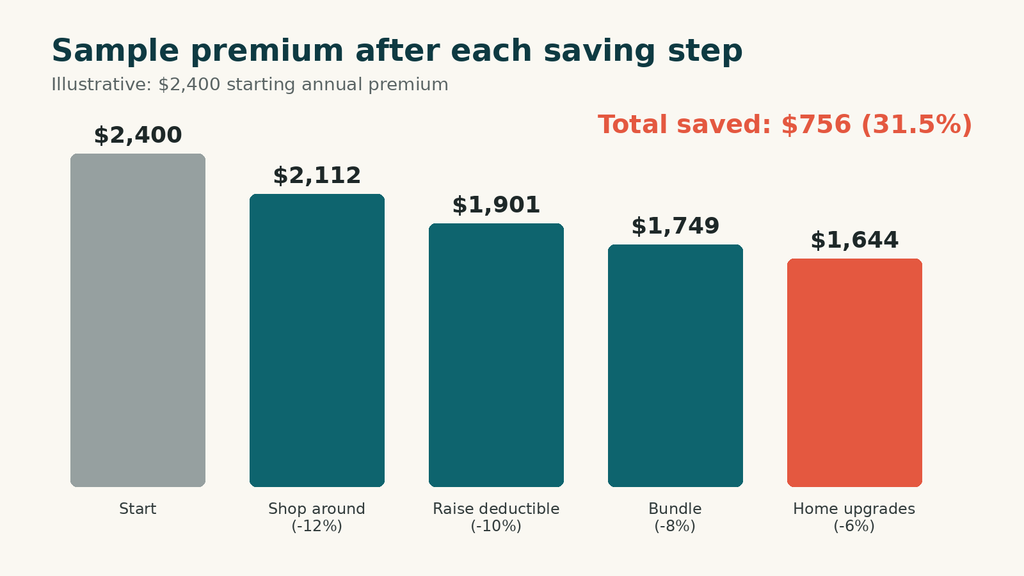
Suppose your annual premium is $2,400. Shopping around cuts 12%, taking it to about $2,112. Raising the deductible from $1,000 to $2,500 saves roughly 10% more, to about $1,901. Bundling with your auto insurance trims another 8%, to roughly $1,749. Finally, a monitored alarm, leak sensors and a documented roof upgrade take off about 6%, ending near $1,644. That is a drop of about $756, or roughly 31%.
Your numbers will differ, and some homes in high-risk areas have fewer options. But the approach holds: no one change is a miracle, and several modest ones compound.
Your action plan
- Pull your current declarations page and fix any errors.
- Collect at least five like-for-like quotes before your renewal date.
- Choose a deductible you can comfortably cover from savings.
- Compare bundled and unbundled pricing.
- Ask your insurer which home upgrades and devices earn credits.
- Request every discount by name.
- Set a calendar reminder to repeat this process annually.
An hour of comparison and a few phone calls can return hundreds of dollars a year. Do it before your next renewal, and you will likely never accept the first number again.
General information only, not financial or insurance advice. Discounts, rules and savings vary by insurer, location and property; confirm details with a licensed agent.
Please wait…
Your Code
This code is fixed and not randomly generated.