Life insurance exists to protect the people who depend on you financially if you die. Picking a policy can still feel confusing, because agents, websites, and friends often give opposite advice. The core choice is between term life and whole life, and the right answer depends on what you’re protecting and what you can afford.
The Short Answer
For most people with a family, a mortgage, or other temporary financial responsibilities, term life is usually the more practical starting point. It’s much cheaper and delivers the most coverage per dollar. Whole life can make sense in specific situations, such as lifelong dependents or estate planning, but it costs far more.
What Is Term Life Insurance?
Term life covers you for a set period, commonly 10, 20, or 30 years. If you die during that term, your beneficiaries receive the death benefit. If you outlive the term, the policy simply ends and pays nothing.
Key features:
- Lower premiums. You’re paying only for protection, with no savings component.
- Level premiums. Your rate stays the same throughout the term.
- No cash value. There’s nothing to withdraw or borrow against.
- Temporary coverage. When the term ends, you can usually renew, but at a much higher price, or you can buy a new policy at your older age.
What Is Whole Life Insurance?
Whole life is a type of permanent insurance. As long as you keep paying premiums, it covers you for your entire life, and the death benefit is guaranteed.
It also includes a cash value account that grows slowly over time. You can borrow against it or, in some cases, withdraw from it. Some policies from mutual insurers also pay dividends, though dividends aren’t guaranteed.
Key features:
- Lifelong coverage. There’s no expiration date as long as premiums are paid.
- Fixed premiums. The price doesn’t increase as you age.
- Cash value growth. A portion of each premium builds a savings component at a modest, set rate.
- Much higher cost. You’re buying both insurance and a long-term savings feature.
How Much Do They Cost?
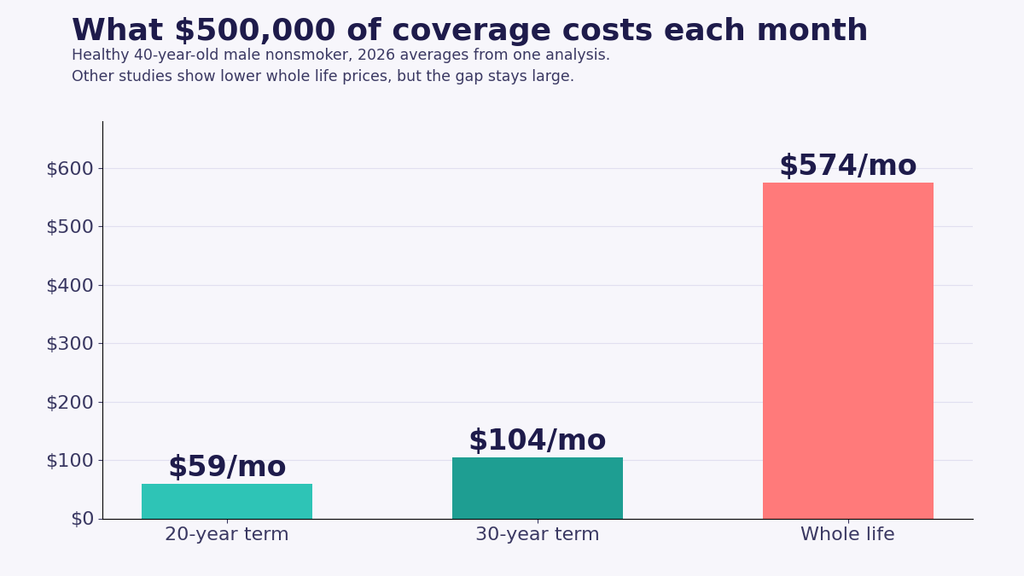
In one 2026 analysis, a healthy 40-year-old nonsmoking man paid about $59 a month for a 20-year, $500,000 term policy and about $104 a month for a 30-year term. A whole life policy with the same $500,000 death benefit averaged $574 a month. Over 30 years, that analysis put the extra cost of whole life at about $185,400 compared with the 20-year term, before counting the cash value it builds.
Published figures vary by source, and prices depend on your age, sex, health, and tobacco use. Other studies show lower whole life prices. But the pattern holds: whole life commonly costs several times as much as term, and often close to ten times as much.
The Real Trade-Off
With term life, you pay a low price for a big amount of protection, but only for a limited time. With whole life, you pay a high price for coverage that never expires, plus a cash value.
Cash value sounds appealing, but it deserves a closer look. In the early years, most of your premium goes toward the cost of insurance, fees, and commissions, so the cash value grows slowly. If you cancel in the first years, you may get back far less than you paid. Borrowing against the policy is possible, but unpaid loans and interest reduce the death benefit.
Who Usually Fits Term Life?
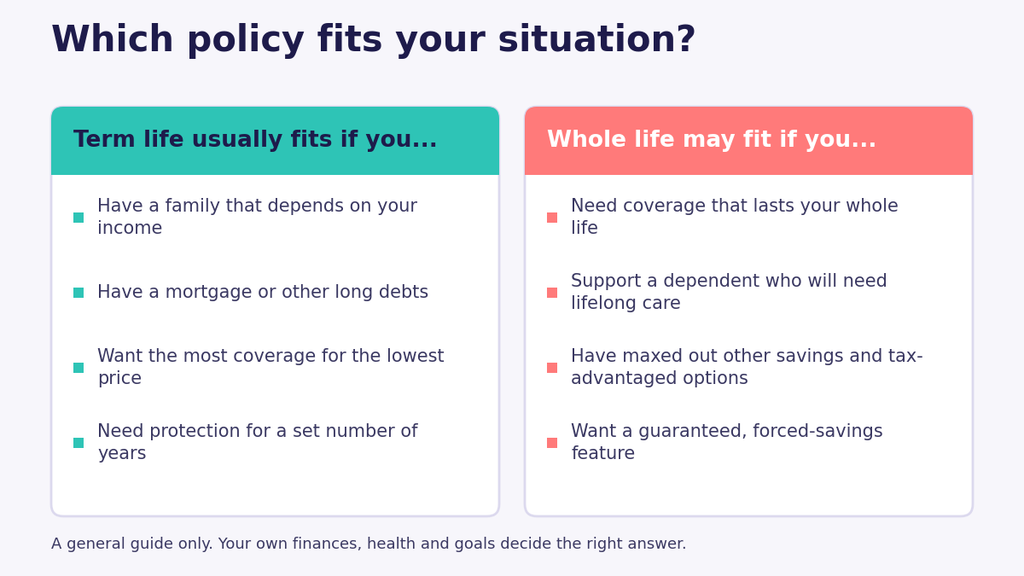
Term tends to work best if you:
- Have a spouse, partner, or children who rely on your income
- Have a mortgage, student loans, or other long-term debts
- Want the highest coverage for the lowest premium
- Need protection for a defined period, such as until the kids are grown or the mortgage is paid
A common rule of thumb is to match the term to your longest financial obligation, such as a 25-year mortgage.
Who May Want Whole Life?
Whole life isn’t a bad product, just a specialized one. It may make sense if you:
- Need coverage that lasts your entire life, such as to leave an inheritance or cover final expenses no matter when you die
- Support a family member, such as a child with special needs, who will rely on your financial help for life
- Have already maxed out other tax-advantaged savings options and want another vehicle
- Have a complex estate or business situation that benefits from permanent coverage
If you’re considering whole life, talk to a fee-only financial planner who doesn’t earn a commission on the sale.
“Buy Term and Invest the Difference”
A popular piece of advice is to buy cheap term insurance and invest the savings instead of paying for whole life. If whole life costs several hundred dollars more per month, investing that difference could potentially build more wealth than the policy’s cash value, though returns aren’t guaranteed and markets can fall.
It only works if you actually invest the difference, month after month. Some people find whole life’s forced savings keeps them disciplined. Others prefer flexibility and lower fees. Either can be reasonable if you understand the costs.
Other Options Worth Knowing
- Convertible term. Some term policies let you convert to permanent coverage later without a new medical exam. That can be a useful safety net.
- Laddering. You buy several smaller term policies with different lengths, so coverage drops as your needs shrink.
- Universal life. Another form of permanent insurance with flexible premiums. One analysis found it costs roughly a third less than whole life, but still several times the price of term.
How Much Coverage Do You Need?
There’s no universal answer, but many advisers suggest starting with 10 to 15 times your annual income. A more tailored approach adds up your debts, future costs such as college, and several years of income replacement, then subtracts savings and existing coverage.
Common Mistakes
- Buying too little coverage because the premium looks high. Term makes larger amounts affordable.
- Waiting too long. Premiums rise with age and health problems.
- Letting a term policy lapse without replacing coverage you still need.
- Not updating beneficiaries after major life events.
How to Decide
- List who depends on your income and for how long.
- Add up your debts and expected future costs.
- Check how much you can comfortably pay each month.
- Get quotes for term, and for whole life if you have a specific reason to consider it.
- Compare policies from several insurers, and consider speaking with an independent adviser.
The Bottom Line
If you need protection for your family during your working years, term life usually delivers it at a fraction of the cost. Whole life is better suited to lifelong needs, estate planning, or people who have already covered the basics and want permanent coverage. The best policy is the one that fits your obligations, your budget, and your goals, and one you’ll actually keep paying for.
Disclaimer: This article is for general information only and is not financial, insurance, or legal advice. Prices are examples from published 2026 averages and vary by insurer, age, health, and location. Consult a licensed professional about your situation.
Please wait…
Your Code
This code is fixed and not randomly generated.