Ask five drivers what they pay for car insurance and you’ll get five very different answers. That’s because the price depends on where you live, how old you are, what you drive, and how much coverage you buy. Still, averages give you a useful yardstick. If your quote is far above them, it’s worth shopping around.
This guide explains what drivers typically pay in 2026, how rates differ across the country, and how to bring your own bill down.
The National Average in 2026
Studies don’t agree on one number, because each uses different driver profiles and data. In general, 2026 research puts the national averages in these ranges:
- State minimum coverage: roughly $50 to $100 a month. Several studies land between about $590 and $910 a year.
- Full coverage: roughly $180 to $215 a month, or about $2,200 to $2,600 a year. One widely cited analysis puts the figure at $208 a month, or about $2,500 annually.
So when you compare your quote, check which kind of coverage the average refers to. A “minimum coverage” average will make any full coverage policy look expensive.
Minimum vs. Full Coverage
These terms cause a lot of confusion, so here’s the plain version.
Minimum coverage meets your state’s legal requirement, which usually means liability insurance. It pays for injuries and property damage you cause to other people. It doesn’t pay to fix your own car.
Full coverage isn’t an official policy type. It generally means liability plus collision (damage to your car from a crash) and comprehensive (theft, fire, weather, and similar losses). Many lenders require it while you’re paying off a car loan.
Full coverage costs roughly three times as much as the minimum in most data sets, but it protects your own vehicle and finances far better.
Average Car Insurance Cost by State
State is one of the biggest factors in your rate. Claim frequency, repair and medical costs, weather, traffic density, theft, fraud, and state insurance laws all play a part.
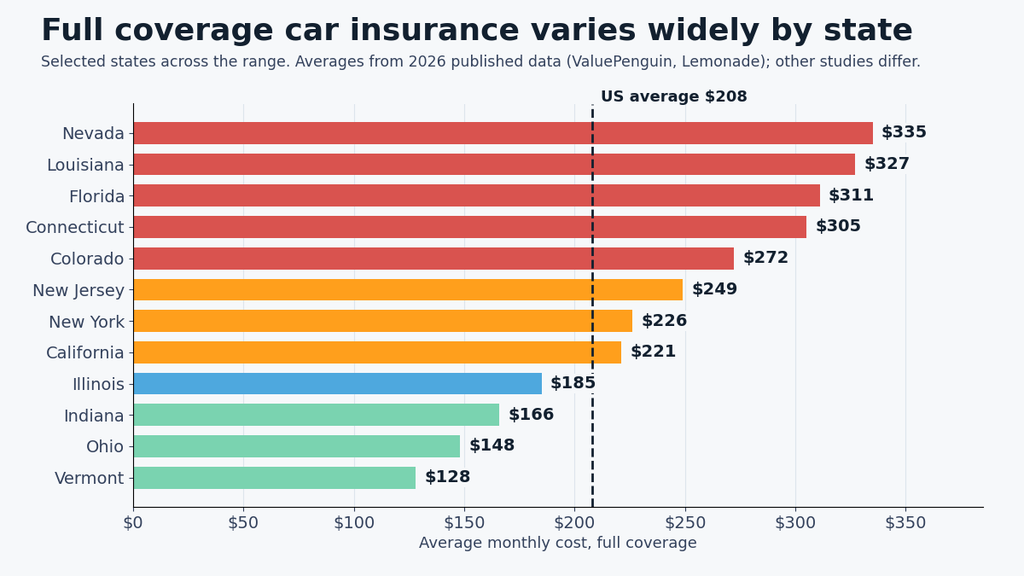
The chart shows a sample of states using 2026 published averages for full coverage. A few things stand out:
- Nevada is at the high end at about $335 a month, more than two and a half times Vermont’s average.
- Louisiana, Florida, and Connecticut also run above $300 a month.
- Colorado averages around $272 a month, while New Jersey, New York, and California fall between roughly $220 and $250.
- Illinois, Indiana, and Ohio are cheaper, at roughly $150 to $185 a month.
- Vermont is the lowest in this data at about $128 a month. Maine, Wyoming, and New Hampshire are also under $135 a month.
The gap between neighboring parts of the country can be huge. Full coverage in Florida averages around $311 a month compared with about $148 in Ohio, which is more than double.
Other studies show the same pattern with different numbers. One analysis found full coverage ranging from about $1,660 a year in Vermont to nearly $4,000 a year in Louisiana. On the minimum-coverage side, the same research put Wyoming near $399 a year and New Jersey near $1,395. The exact dollar amounts differ by source, but the same states keep appearing at the top and bottom.
Why Your Rate Is Different From the Average
Two drivers in the same state can pay very different amounts. Insurers weigh many factors, and most of them are within your control only partly.
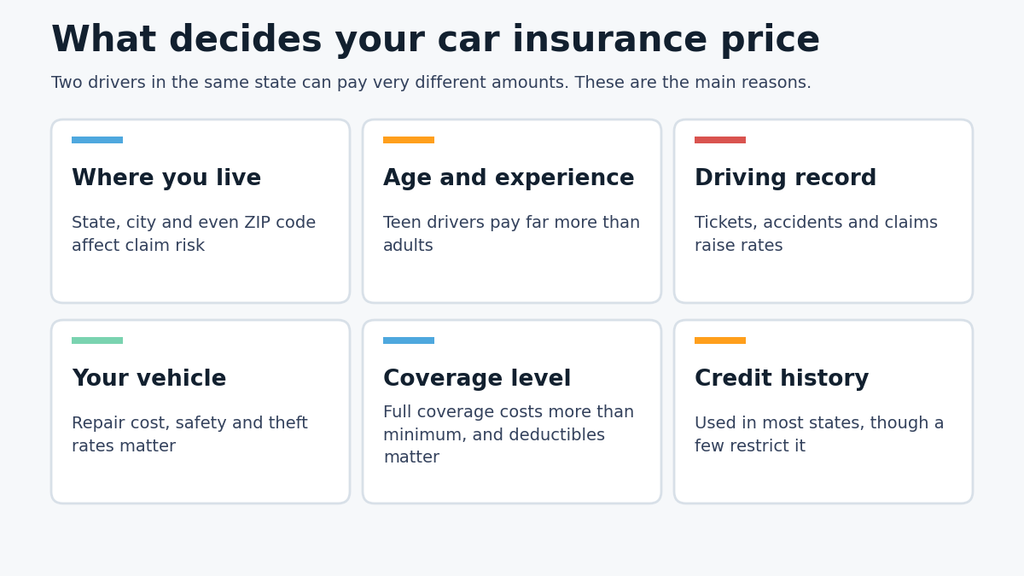
Age and experience. Young drivers pay the most. In one 2026 analysis, full coverage for a 16-year-old averaged around $8,013 a year, compared with about $5,086 for a 19-year-old. Rates generally fall as drivers gain experience.
Driving record. Accidents, speeding tickets, and DUI convictions raise your premium, often for several years.
Your vehicle. Cars that are expensive to repair, popular with thieves, or fast tend to cost more to insure. Safety features can help.
Coverage and deductible. Higher liability limits and lower deductibles increase your premium. A higher deductible lowers it, but you’ll pay more out of pocket after a claim.
Credit history. In most states, insurers use credit-based information in pricing. A few states restrict the practice, so check your state’s rules.
Location within your state. City, ZIP code, and local claim rates matter. Urban areas are usually more expensive than rural ones.
Prices have also risen in recent years because of inflation, higher repair costs, and more expensive accident claims, which is why even drivers with clean records often see increases at renewal.
How to Lower Your Car Insurance Bill
You can’t change your state, but you can still cut your cost.
- Compare quotes from several insurers. Prices for the same driver can vary a lot from one company to the next. Get at least three to five quotes, and compare identical coverage.
- Ask about discounts. Common ones include bundling home and auto, safe driver, good student, low mileage, multi-car, and discounts for safety features.
- Raise your deductible. Moving from a $500 to a $1,000 deductible can reduce your premium. Make sure you could pay the higher amount from savings.
- Consider usage-based insurance. Programs that track your driving through an app or device can reward safe habits.
- Review your coverage each year. If your car is old and worth little, collision and comprehensive coverage might not be worth the cost.
- Keep a clean record. Avoiding tickets and claims is one of the most reliable ways to keep your rate low over time.
- Shop again after life changes. Moving, getting married, changing jobs, or paying off a car can all affect your price.
A Few Cautions
The cheapest policy isn’t always the best. Minimum coverage may leave you exposed if you cause a serious accident, because your liability limits could be lower than the damage. Before choosing the lowest-priced option, think about your assets and how much risk you can afford.
Also remember that every number in this article is an average. Your quote can be higher or lower, and rates change often. Treat the averages as a benchmark, not a prediction.
The Bottom Line
Car insurance in 2026 averages roughly $50 to $100 a month for minimum coverage and about $180 to $215 a month for full coverage, but your state can swing that figure by more than $200 a month. Nevada, Louisiana, Florida, and Connecticut sit at the expensive end, while Vermont, Maine, and Ohio are among the more affordable. The best way to find your real price is to compare multiple quotes with the same coverage, use every discount available, and recheck your rate at least once a year.
Disclaimer: This article is for general information only and is not insurance, financial, or legal advice. Figures are averages from published 2026 studies and vary by source, driver, and insurer. Get personalized quotes and confirm your state’s minimum requirements before buying a policy.
Please wait…
Your Code
This code is fixed and not randomly generated.